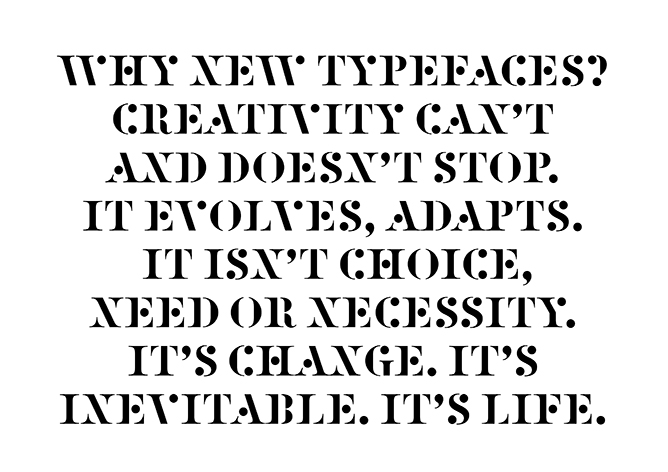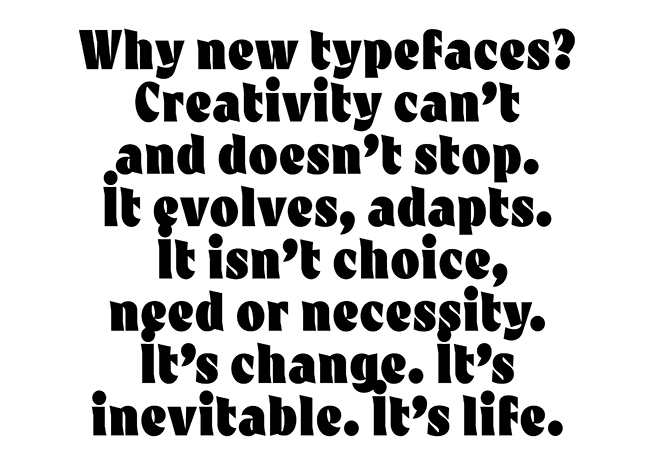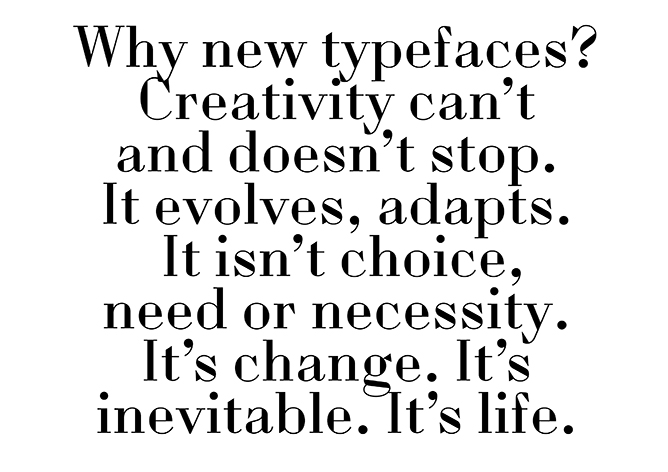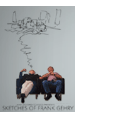
Film for the New Zealand Book Council, produced by Colenso BBDO and animated by Andersen M Studio.

And you can snag a copy of Maurice Gee’s Going West here.
Found via Daniel Will-Harris

‘Watch the definitive documentary on the husband-wife design icons’
A new biography on Charles and Ray Eames is airing on PBS this week. Powerful and unflinching, more than just chairs. Playful optimism, powerful clients, amazing budgets, odd obsessions. Narrated by James Franco, titles feature the incredible Eames fonts.
Watch it online here.
Above, the IBM Pavilion at the 1964 Worlds Fair.
Below, Eames’ complete short film The Information Machine. Commissioned in 1958 by IBM, it was designed to get a fearful population to trust this perceived-dangerous, unknown mechanical variable: Computers!

‘The rectangles on top of each label represent main ingredients, and bars on the bottom provide a quick thumbs or thumbs down for a breakdown of fat content, carbohydrates, etc. Icons of spoons and scoops are used to supplement serving size since no one knows what 182 grams looks or feels like.’
Above, Renee Walker’s food nutrition label redesign, winner of UC Berkeley School of Journalism’s Rethink the Food Label competition.
Her work was originally part of an interdisciplinary topic studio focused on contemporary health issues; she has her original versions posted here.
Below, a few of my favorites from the competition:

Corinne Pritchard

Fabius Leineweber

Bradley Mu
Found via FlowingData

Final project from my beginning typography course at American River College: Futura Condensed Extra Bold, crafted as iced chocolate cake by student Lilie Matyuk.
Food-based type is always a tricky undertaking, but luckily we had Teresa Urkofsky teaching next door – in the culinary classroom. Teresa had recipes and techniques ready to advise.
I’ve been drawing some form of type since the 1980s. And have been teaching type for several years now.
It’s hard to ‘go digital’ when introducing typography, since letterform history goes back hundreds (and thousands) of years.
So I still use 15th century era handtools in my introductory type courses.
Good fonts still contain elements from long ago – and today, all we really do is recreate what was once done with broad pens – using digital tools.
font games!
To get a taste of how ‘us professionals’ render type these days, check out Mark MacKay’s brilliant Shape Type (pictured above) and Kern Type. Both are nutshell adaptations of today’s process – kerning being a majorly overlooked, but necessary typesetting skill.
digital type tools
Fonts today are vector-based, so a mastering the basics of Adobe Illustrator is the start.
Beyond this, there are a bunch of applications on the market for drawing fonts. FontLab is the big one, Fontographer is the old one with the easy interface – and TypeTool is a barebones student-discounted alternative. Unlike Illustrator, these font tools take into account how letters are drawn, with built ins that make it easy to adjust edges. Karen Cheng’s Designing Type is also a must resource to have.
And I do all my logo drawings directly in FontLab – after multiple sketches in pen and ink. It’s just easier that way.
Shape Type found via Mark Nutini
Change to Win’s animate of ‘The End of the American Dream?’ – done in the style of RSA Animate.
Found via Occupy San Francisco

‘What role we are playing. Making the filthy oil company look ‘clean,’ making the car brochure higher-quality than the car, making the spaghetti sauce look like it’s been put up by grandma, making the junky condo look hip. Is all that okay, or just the level to which design and many other professions have sunk?’ –Tibor Kalman
I first discovered Tibor Kalman’s work sometime around 1990.
He was doing something that most everyday graphic designers seemed to be avoiding. Questioning things.
His adeptness at social change – being a responsible human being, helping others – happened by working within the system. First at Barnes & Noble, M&Co., then Interview, Colors magazines. And as a teacher.
Before he passed in 1999, Kalman was the facilitator of what I see as a great awakening in our industry. And those who were part of his circle – such as his wife Maira, Stefan Sagmeister, Scott Stowell, Alexander Isley – have made graphic design much more than pretty brochures and generic logotypes.
Good design for good purposes is good. Making shitheads lots of money thru questionable practices is bad. Seems simple, right?
It isn’t.
I posted this because the rest of the world is waking up just about right now. And this past week, Steven Heller wrote up a great piece on Kalman.


Pictured from top down, advertisements and promotions for NYC’s Restaurant Florent. With Alexander Isley, from 1985–88. Found via Tibor Kalman: Design and Undesign and MoMA

‘Drop caps not bombs’
An anonymously-created stencil interpretation of myself – spotted last quarter on the wall at the Art Institute of California Sacramento.
(Okay, I know which student made it, but I ain’t tellin)
‘I’ve been doing posters for tons of cities across America’
In the past few weeks, one of my former students has found herself cast as the visual heart of the Occupy movement. Raina Dayne started with offering to do a poster and it’s blossomed into something much bigger.
Raina’s images can be downloaded for use at the Occupy Together website. Facebook page here, shirts here.

‘Your time is limited, so don’t waste it living someone else’s life. Don’t be trapped by dogma – which is living with the results of other people’s thinking. Don’t let the noise of others’ opinions drown out your own inner voice. And most important, have the courage to follow your heart and intuition. They somehow already know what you truly want to become. Everything else is secondary.’ –Steve Jobs
Intuition is very powerful, once one knows how to trust it. It involves turning off the insecurities of ego and concentrating on pure feeling. And it works wonders.
The news of Steve Jobs’ passing came in via social media. I saw a Facebook post right after I gave a design history lecture on early modern artists and how they’d managed to change the world.
I was fortunate enough to both go to school and work in and around Silicon Valley where Jobs’ approach reverberates and inspires. Playing it safe, following the status quo will not lead to new things, will not improve life as we know it – and Jobs knew how to get the best work out of Apple’s creative team.
He knew that details are excruciatingly important. Leveraging design, using good typography, giving us what we really want – instead of what we think we need – was all part of the package.
Thinking different makes the world a better place. That’s the legacy he leaves.
Image by Dylan Roscover, using Apple’s suite of fonts from over the years